Persons of Interest–Ray Kurzweil

“By understanding the information processes underlying life, we are starting to learn to reprogram our biology to achieve the virtual elimination of disease, dramatic expansion of human potential, and radical life extension.” – Ray Kurzweil, The Singularity Is Near With … Continue reading

More Galleries | Tagged , , , , , | Leave a comment

Large Space Vessels — Toroids

torus-adobestock_41816612A toroid is a figure shaped like a torus. Common examples abound, such as rings, hoops and doughnuts. It’s an attractive shape for large space vessels, and it appears in numerous science-fiction settings as well as on the drawing boards of space agencies. For a general introduction to large space vessels, CLICK HERE. For an examination of the alternative popular design, cylindrical vessels, CLICK HERE.

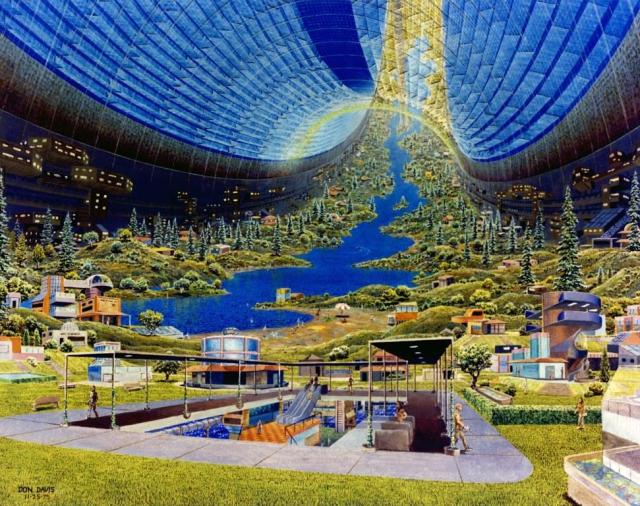
The toiroidal design has many advantages, including the simplicity of its physics. The basic idea is to construct an enclosed ring, fill it with atmosphere, and spin it to create the illusion of gravity on the far inside surface of the structure. NASA has been studying the design for a long time, and many of its illustrations from the 1970s are available on its website, including the following:

torus_interior_ac75-2621_1920

Stanford Torus. Image Credit: NASA/Ames

The above image depicts a fairly large torus suitable for housing a space colony. The idea of a structure this size includes a self-sustaining ecosystem, which, if accomplished, could potentially render proximity to Earth unnecessary.

Smaller scale space stations can also be designed utilizing the structure. In the 1968 classic science fiction film 2001: A Space Odyssey (directed by Stanley Kubrick, screenplay by Stanley Kubrick and Arthur C. Clarke), the fictional Space Station V is a spinning set of rings with artificial gravity created by spin. The exterior of Space Station V look something like the following:

space-station-adobestock_20271632

While the interior is depicted as a pristine environment with a curved floor that would circumscribe the entire far inner surface, as shown in this shot of the set:

station_v_01

Interior of Space Station V. Note the upward curve along the corridor.

The following 1970s NASA video includes a good sequence showing a spinning toroidal space station:

The 2013 film Elysium, starring Matt Damon and Jodie Foster (TriStar Pictures, directed by Neill Blomkamp) features a toroidal design, with the added feature of an open interior side. The space city, Elysium, is the utopian home of the privileged, while everyone else lives on a ravaged Earth. The trailer provides some great glimpses of the toriodal vessel orbiting Earth.

In fiction, toroidal vessels can become quite large–to the point of constituting structures the size of a planet or greater. A popular example of a very large torus, circling a sun, is the eponymous ringworld in Larry Niven’s Ringworld, which, in 1971, took the trifecta of winning the Nebula Award, Hugo Award and Locus Award for best novel.

Simon Terrey has a very good illustrative rendering of a ringworld on Youtube:

The science fiction Culture series, written by Scottish author Iain M. Banks, features ring-shaped habitats called “Orbitals” that are spread across the galaxy. Banks describes them as resembling “a god’s bracelet” hanging in space. Varying in size and smaller than Niven’s Ringworld (but much larger than a Stanford Torus), Orbitals are nevertheless extraordinarily large, often 10 million kilometers or more in circumference housing billions. The popular military science fiction first-person-shooter video game franchise, Halo, features similar artificial worlds. In fact, the name “Halo” refers to the Halo rings, similar to Banks’s Orbitals. The game universe centers on an interstellar war between humanity and an alliance of aliens known as the Covenant.

Similarly, “Bishop” rings are a common habitat in the universe of the Orion’s Arm world-building project, with rings of a 1,000 kilometer radius capable of supporting populations in the tens of billions. For images and more information about the differences between a Ringworld, a Banks Orbital, and a Bishop ring, see the Orion’s Arm overview of these habitats at its Encylopaedia Galactica entry HERE.

With respect to these large structures (and also the open-ceiling design of the space city in Elysium) , it seems that one key engineering problem or vulnerability goes to the question of keeping the atmosphere in. Despite their substantial gravity, planets leak atmosphere all the time. A structure that relies on inertia to simulate gravity will find problems keeping the atmosphere in without an enclosed interior surface. There is also the risk of a catastrophic puncture in a side wall through which atmosphere vent rapidly. Better materials than those known at present might be necessary. Force field technologies could be very handy as well.

Scaling back down from Orbitals, Halos and Bishop rings, other examples of enclosed toroidal space stations and ships abound in popular fiction. For instance, the science fiction television series Battlestar Gallactica includes the Zephyr passenger liner.

The PlayStation 2 video game Zone of the Enders, by Hideo Kojima, is also set aboard a Stanford torus-type space station orbiting Jupiter called Antillia Colony. According to its website, the “Taurus-type colony was constructed on the Jupiter moon Europa L5 as a support base for the excavation of Jupiter’s resources. It is the most remote of all civilian outposts, and exists as a residential colony of roughly 100,000 laborers who work to excavate and transport Helium 3 and Metatron resources from the mines.”

Startopia screenshot–curved interior of toroidal space station.

Startopia is a real-time strategy/city-management computer game specifically set in a series of toroidal space stations. In a post-apocalyptic future, it is the player’s goal to rebuild the once-thriving network of toroidal space-stations, each of which is divided into three decks and split into several sections with bulkheads. Its website includes screenshots of the interior of the space stations.

There are many other examples. Overall, it seems these vessels are extraordinarily popular, and their practicality makes them wonderful candidates for science fiction settings, as well as a reasonable direction for research into making human colonization of space a reality.

Posted in Science, Science Fiction, Space Vessels | Tagged , , , , , , , , , | 2 Comments

2017 Audie Award Nominees in Science Fiction

The Audie Nominations have been announced. I, for one, am a steady audiobook consumer, and I’m always interested in learning what people think are the best in any category. The Audies®, sponsored by the Audio Publishers Association (APA), is the “premier awards program in the United States recognizing distinction in audiobooks and spoken-word entertainment. Publishers and rights holders enter titles in various categories for recognition of achievement. Finalists are selected, and from that group of finalists one winner is awarded.”

The APA’s Mission Statement:

Formed in 1986, the Audio Publishers Association (APA) is a not-for-profit trade association that advocates the common, collective business interests of audio publishers. The APA consists of audio publishing companies and suppliers, distributors, and retailers of spoken word products and allied fields related to the production, distribution, and sale of audiobooks.

The awards are granted annually in many different categories, including genres and specific performance categories. For now, let’s look at Science Fiction. Following are the 2017 nominees in that category, with the publisher’s blurb for each selection, with picture links to the works as available at www.audible.com:
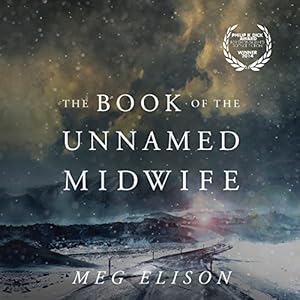
The Book of the Unnamed Midwife: The Road to Nowhere, Book 1
Written by: Meg Elison
Narrated by: Angela Dawe
Length: 9 hrs and 14 mins

Philip K. Dick Award Winner for Distinguished Science Fiction

When she fell asleep, the world was doomed. When she awoke, it was dead.

In the wake of a fever that decimated the earth’s population – killing women and children and making childbirth deadly for the mother and infant – the midwife must pick her way through the bones of the world she once knew to find her place in this dangerous new one. Gone are the pillars of civilization. All that remains is power – and the strong who possess it.

A few women like her survived, though they are scarce. Even fewer are safe from the clans of men, who, driven by fear, seek to control those remaining. To preserve her freedom, she dons men’s clothing, goes by false names, and avoids as many people as possible. But as the world continues to grapple with its terrible circumstances, she’ll discover a role greater than chasing a pale imitation of independence.

After all, if humanity is to be reborn, someone must be its guide.
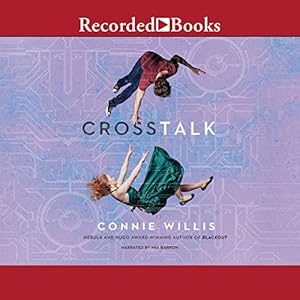
Crosstalk
Written by: Connie Willis
Narrated by: Mia Barron
Length: 18 hrs and 45 mins

Part romantic comedy and part social satire, here one of science fiction’s most lauded authors examines the consequences of having too much connectivity, and what happens in a world where, suddenly, nothing is private. One of science fiction’s premiere humorists turns her eagle eye to the crushing societal implications of telepathy.

In a not-too-distant future, a simple outpatient procedure that has been promised to increase empathy between romantic partners has become all the rage. So when Briddey Flannigan’s fiancé proposes that he and Briddey undergo the procedure, she is delighted! Only, the results aren’t quite as expected. Instead of gaining an increased empathetic link with her fiancé, Briddey finds herself hearing the actual thoughts of one of the nerdiest techs in her office. And that’s the least of her problems.

The Dispatcher
Written by: John Scalzi
Narrated by: Zachary Quinto
Length: 2 hrs and 19 mins

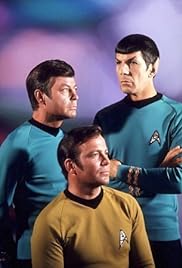
Zachary Quinto – best known for his role as the Nimoy-approved Spock in the recent Star Trek reboot and the menacing, power-stealing serial killer, Sylar, in Heroes – brings his well-earned sci-fi credentials and simmering intensity to this audio-exclusive novella from master storyteller John Scalzi.

One day, not long from now, it becomes almost impossible to murder anyone – 999 times out of a thousand, anyone who is intentionally killed comes back. How? We don’t know. But it changes everything: war, crime, daily life.

Tony Valdez is a Dispatcher – a licensed, bonded professional whose job is to humanely dispatch those whose circumstances put them in death’s crosshairs, so they can have a second chance to avoid the reaper. But when a fellow Dispatcher and former friend is apparently kidnapped, Tony learns that there are some things that are worse than death and that some people are ready to do almost anything to avenge a supposed wrong.
It’s a race against time for Valdez to find his friend before it’s too late…before not even a Dispatcher can save him.
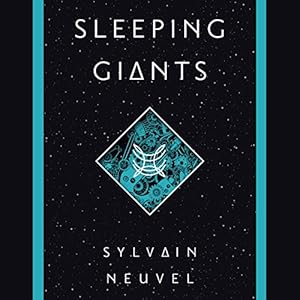
Sleeping Giants
Written by: Sylvain Neuvel
Narrated by: full cast
Length: 8 hrs and 28 mins

An inventive debut in the tradition of World War Z and The Martian, told in interviews, journal entries, transcripts, and news articles, Sleeping Giants is a literary thriller fueled by a quest for truth – and a fight for control of earthshaking power.

A girl named Rose is riding her new bike near her home in Deadwood, South Dakota, when she falls through the earth. She wakes up at the bottom of a square hole, its walls glowing with intricate carvings. But the firemen who come to save her peer down upon something even stranger: a little girl in the palm of a giant metal hand.

Seventeen years later, the mystery of the bizarre artifact remains unsolved – its origins, architects, and purpose unknown. Its carbon dating defies belief; military reports are redacted; theories are floated, then rejected.

But some can never stop searching for answers.

Rose Franklin is now a highly trained physicist leading a top-secret team to crack the hand’s code. And along with her colleagues, she is being interviewed by a nameless interrogator whose power and purview are as enigmatic as the provenance of relic. What’s clear is that Rose and her compatriots are on the edge of unraveling history’s most perplexing discovery – and figuring out what it portends for humanity. But once the pieces of the puzzle are in place, will the result prove to be an instrument of lasting peace or a weapon of mass destruction?
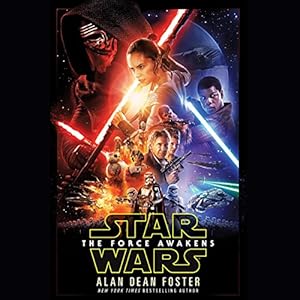
Star Wars: The Force Awakens
Written by: Alan Dean Foster
Narrated by: Marc Thompson
Length: 10 hrs and 21 mins

A New York Times best seller: The official novelization of Star Wars: The Force Awakens, the blockbuster film directed by J. J. Abrams.

More than 30 years ago, Star Wars burst onto the big screen and became a cultural phenomenon. Now the next adventures in this blockbuster saga are poised to captivate old and new fans alike – beginning with the highly anticipated Star Wars: The Force Awakens. And alongside the cinematic debut comes the thrilling novel adaptation by New York Times best-selling science fiction master Alan Dean Foster.

Set years after Return of the Jedi, this stunning new action-packed adventure rockets us back into the world of Princess Leia, Han Solo, Chewbacca, C-3PO, R2-D2, and Luke Skywalker, while introducing a host of exciting new characters. Darth Vader may have been redeemed and the Emperor vanquished, but peace can be fleeting, and evil does not easily relent. Yet the simple belief in good can still empower ordinary individuals to rise and meet the greatest challenges.

So return to that galaxy far, far away, and prepare yourself for what happens when the Force awakens.

Posted in Uncategorized | 1 Comment

Large Space Vessels — Cylinders

Taking a closer look at large cylindrical vessels, several types and examples appear in space agency research projects as well as books, movies, TV and video games. (For the introductory overview of this topic, see Large Space Vessels.)

The 1970s design of a rotating cylinder for housing thousands of residents is known as an O’Neill cylinder, named after American physicist Gerard K. O’Neill, who proposed the design in his 1976 book, The High Frontier: Human Colonies in Space, in which he mapped out a practical path for humans in sustainable space habitats using 1970s material and know-how. It has been reprinted, revised and updated since its first publication.

A more recent design is the McKendree cylinder, a rotating space habitat originally proposed in 2000 by NASA engineer Tom McKendree. The design differs from an O’Neill cylinder in that it uses carbon nanotubes instead of steel, permitting the cylinders to be huge (over 5 million square miles of living surface–roughly the size of Russia).

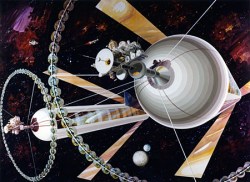
Counter-balanced O'Neil cylinders. Credit: NASA ID Number AC75-1085

Counter-balanced O’Neil cylinders. Credit: NASA ID Number AC75-1085

Among the ideas of both cylinder designs is the notion of a pair of counter-rotating cylinders, balancing each other out like momentum wheels to control orientation, since the plan was to make a relatively stationary habitat near Earth (as opposed to an interstellar vessel) with proper orientation with respect to the sun. Counterbalanced cylinders are not the only way to maintain orientation. However, this is an interesting idea that also doubles the surface space available for residents.

A space city of the O’Neil or McKendree variety can be seen at the very end of the recent movie, Interstellar. The science-fiction television series Babylon 5 also features a cylindrical, stationary space city. Two recent popular novels also feature, among other things, cylindrical space cities. In the Nebula Award wining novel2312, by Kim Stanley Robinson, there are many space habitats created from hollowed-out asteroids, called “terraria,” that are a form of spinning O’Neill cylinders. There are also cylindrical space-city vessels in Death’s End, the third installment of the Remembrance of Earth’s Past trilogy, translated by Ken Liu (English translation published 2016). The first two novels in the trilogy were The Three Body Problem (a Hugo Award winner) and The Dark Forest), by Liu Cixin (刘慈欣).

In addition to being good habitats for local (within the solar system) space cities, the cylindrical design seems ideal for long-term travel between stars. A large cylinder can house thousands, or even tens of thousands, of residents. Movement in a single direction along the axis of spin should keep the vessel properly oriented, although it might make course changes more difficult. The annals of science fiction abound with cylindrical colony ships traversing the void to reach distant stars in journeys that will take centuries or more. That is the design of the troubled Peerless colony ship in the novel, Towers of Earth (to be released this Spring). It is also the design of the massive alien vessel in Arthur Clarke’s acclaimed novel, Rendezvous with Rama, which will hopefully be a movie some day. Another classic example is Robert A. Heinlein’s Orphans of the Sky, featuring a cylindrical vessel in which the residents have lost sight of the nature of their mission. (The topic of generation ships in fiction is a broad one that we will discuss another time).

Probably the biggest potential problem with the cylindrical design is its vulnerability to breach. As ordinarily depicted, the vessel consists of one very large interior space. It is not compartmentalized. In general, there should be a number of layers between the outer hull and the inner open space. It should also be made of something strong enough to resist breach by collision–at least to the point where anything massive enough and/or moving fast enough to tear through the hull will hit with such cataclysmic force that an immediate loss of air might be the least of the colony’s concerns. Still, it’s a lot of atmosphere in one large compartment, and there should be systems in place to minimize that down-side.

As mentioned before, another disadvantage is the risk of falling objects. There is no real “gravity” in the vessel. Anything flying would have to deal with the spin of the ship. Things up in the very center of the cylinder would seem weightless, but as they “fall” from center, they would seem to spiral from a point of view on the surface, and the eventual impact can be devastating.

The interior of ‘Cooper Station’ an seen in Christopher Nolan’s 2014 film ‘Interstellar’, which appears to be based on the notion of a Cylinder Colony. Read more:

On the upside, the interiors can be beautiful, and there should be fewer moving parts than most other designs, making them good candidates for long interstellar voyages.

Describing the interior can be a bit challenging in novels or stories. It is far removed from ordinary experience, so readers might not automatically fill in the pieces with a brief description. The second paragraph of Chapter One of Towers of Earth, which begins in a cylindrical vessel, will describe the setting like this:

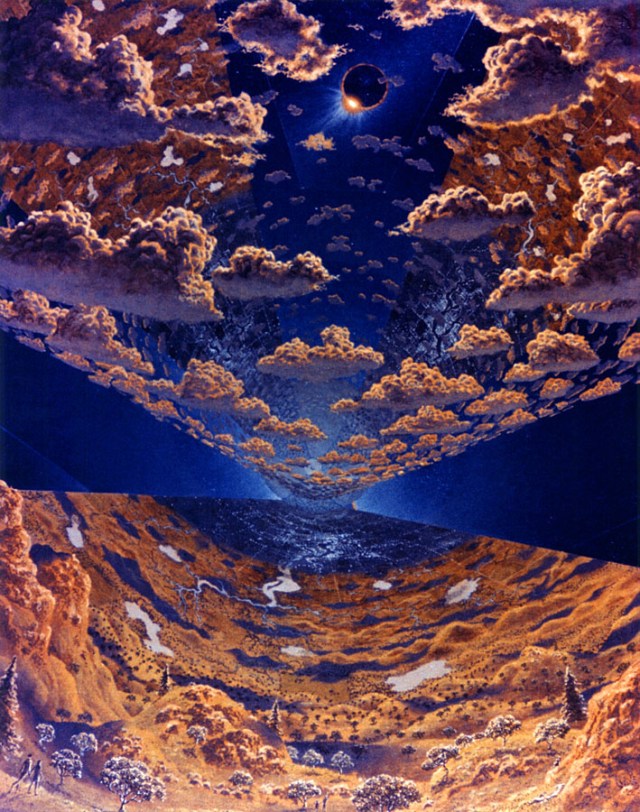
It was noon, with the starship interior fully illuminated. The floor stretched up and curved overhead. Lengthwise, the visible sections of housing, work, and play seemed to adorn the interior like pieces of a child’s game glued to the inside surface of a perfectly round tunnel. It was beautiful in its way. A view that, after all these years, was no longer dizzying.

One thing is for sure, the interior of a massive cylindrical vessel can be breathtaking, and these relatively simple designs might well make a suitable home for many future humans.

Image credit: NASA ID Number AC75-1920

Image credit: NASA ID Number AC75-1920

A small selection of further reading and reference in books, games and TV:

Posted in Science, Science Fiction | Tagged , , , , , , , , , , , | 1 Comment

Extinction Level Events: Gamma Ray Burst

There is a plethora of potential events outside human control that can lead to mass extinction on Earth. It’s happened before. Fortunately, such events are few and far between. Nevertheless, it is worth paying attention to the potential for at least a few reasons. First, a little awareness is appropriate where danger lurks. Also, big problems help put small problems into perspective. More importantly, humanity has a way of solving problems, even those that seem insurmountable. One of those potential problems is a Gamma Ray Burst, or “GRB.”

grb-3GRBs are a relatively new discovery. They are extremely energetic explosions that can be as short as ten milliseconds. Astronomers have observed thousands of GRBs over the past five decades. These occurred in distant galaxies, but were powerful enough to detect. If one occurs in our galaxy, even from thousands of light years away, it could cause great harm if Earth is within the cone of the burst. In fact, a GRB is a strong candidate for the Ordovician-Silurian extinctions about 450 million years ago (not Earth’s “worst” extinction event, but about 85% of marine species died, including many of the Trilobite families). Depending on the circumstances, a GRB can either radiate lifeforms directly, or it can destroy Earth’s ozone with catastrophic consequences.

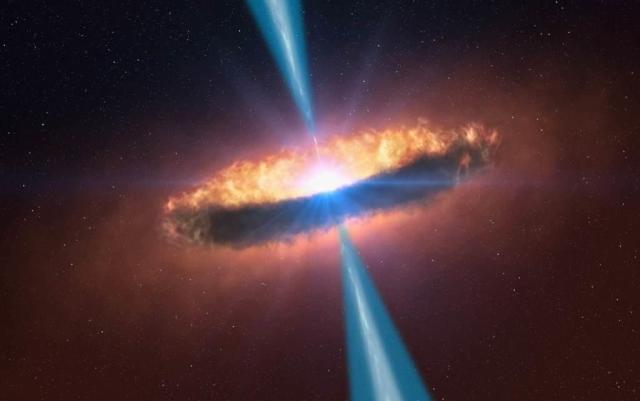
A “long” GRB (lasting from several seconds to several minutes) is the suspected culprit, thought to be caused by the collapse of a “Wolf-Rayet” star, which would be an old, fast-spinning, behemoth star more than 25 times the mass of the sun. Basically, as its core collapses into a black hole, jets of strong radiation shoot outward from its poles at nearly light speed. If the O-S extinctions were caused by a long GRB, the collapsed star would have been somewhere within our galaxy, and its spin axis would have been pointed at Earth. It was too long ago to determine what star (now a black hole) that might have been. Stars move a lot in 450 million years. Our sun makes a full orbit of the galaxy in just 226 million years.

WR 104. Composite image by Christmann. Background credit NASA Hubble Telescope. Inset credit U.C. Berkeley Space Sciences Laboratory, W.M. Keck Observatory.

At present, there is only one Wolf-Rayet star we know of that is close enough (about 7,500 light years) and oriented in such a way (pointed generally toward us) that it might pose an eventual threat — WR 104 in the constellation Sagittarius. It might collapse sometime within the next 500,000 years. Right now it appears to be askew enough to miss us. Hopefully that doesn’t change over the next half-million years. So far, the odds appear to be on our side.

However, be it WR 104 or another local Wolf-Rayet star, the fact remains that long GRBs are a relatively common occurrence in the universe, and some hypothesize them as one answer to the Fermi Paradox, which in essence asks: If there is extraterrestrial intelligence in the universe, why do we not see any sign of it? If galaxies are periodically swept clean of complex organisms by GRBs, then the lifespan of civilizations might be relatively short. See Braun, B., A Possible Answer to Fermi’s Paradox: Gamma-Bursts, Postcards from the Universe, March 29, 2013; Annis. J. An astrophysical explanation for the “great silence”. Journal of the British Interplanetary Society. 52, 19-20 (1999).

Interestingly, although many species perished, life on Earth survived after the GRB hit (if that’s what it was) 450 million years ago. If Earth has another 500 million years before the next blast, how far along might humanity and its technology be? Considering the track record, it is not beyond imagining that we could handle a GRB given hundreds of millions of years to prepare.

Posted in Science, Science Fiction | Tagged , , , , | Leave a comment

Characters

character-adobestock_77642535Characters are at the heart of every story. They do things. Things happen to them. We love them and we hate them. But choosing and developing characters, from protagonists to one-time mentions, can be a challenge.

Here are some quotes and resources about characters. Take them or leave them, but I consider it is essential to bring characters to life, somehow, some way.

“When writing a novel a writer should create living people; people not characters. A character is a caricature.”
― Ernest Hemingway, Death in the Afternoon (Scribners 1954)

“Every character should want something, even if it is only a glass of water.”
― Kurt Vonnegut, Bagombo Snuff Box (Vintage/Ebury 2000)

“Plot is no more than footprints left in the snow after your characters have run by on their way to incredible destinations.”
― Ray Bradbury, Zen in the Art of Writing (Capra Pr 1990)

“Dynamic characters have conflicting emotions and desires and are torn apart by strong emotions, such as ambition and love, or fear and patriotism, or faith and lust, or whatever. Inner emotional fires are raging; forces are pulling dynamic characters in more than one direction. Dynamic characters resolve these inner conflicts by taking actions that will lead to more story conflict and more inner conflict.”
― James N. Frey, How to Write a Damn Good Novel, II (St. Martin’s Press 1994)

“…contrasts make character.”
― Edwin A. Peeples, Professional Storywriter’s Handbook (Doubleday 1960)

Posted in Uncategorized | 1 Comment

Large Space Vessels

space-station-adobestock_20271632

The two most basic design concepts for long-term, high-population space vessels (either orbiting space colonies or ships designed for a long-duration traverse) are the cylindrical model and the toroidal model. NASA and other space agencies have studied these design concepts for decades, and they each appear in numerous science fiction stories and movies.

Both models rely on spin to create the illusion of gravity. In essence, the ship spins around an access. People and things on the inner surface of the outer bulkhead are pressed against the inner surface (which substitutes for a “floor”) by the spin, or more accurately, by their independent inertia as the vessel spins. (Think of swinging a bucket full of water with reasonable speed and the effect of keeping the water in the bucket during the swing.)

This form of artificial gravity isn’t perfect. There is a bit of a lean to it, for instance, although the larger the radius, the less annoying (or noticeable) the lean. The ratio of the spin to the radius determines the strength of the artificial gravity. So either vessel can be designed to provide exactly 1G at the occupied surface, or any other desired degree.

Cylindrical Design

Outside view of a cylindrical vessel on the cover of Arthur C. Clarke’s Rendezvous with Rama.

The cylindrical model is very self-contained. Sir Arthur C. Clarke used this model for the alien vessel in Rendezvous with Rama. Its name describes its shape. It can be short, like a roll of toilet paper, or long like a straw. The spin axis runs down the center of the vessel.

The inside can be nice and open, with atmosphere filling the center and people, houses, trees and lakes plastered against the “sides.” Residents would look up to see people and things appearing upside down on the far side.

Below are NASA concept images of how it might look inside, presuming it could be constructed with ample room for open areas. Both images are intriguing. The second features large “windows” through which sunlight can pass, and the residents can view the night sky.

Image Credit NASA ID NUMBER AC75-1883

Image Credit NASA ID NUMBER AC75-1883

There can be problems with this design. It requires a lot of atmosphere, which is both good and bad. (Good because a large amount of atmosphere is more robust than a small amount; bad because it would take a lot to fill it.) Also, an object falling from anywhere near the center would not fall straight down, but would instead seem to spiral, ultimately scraping the surface at destructive velocity. All of that open space would have to be managed carefully.

Toroidal Design

Large scale toroidal vessel featured on the cover of Larry Niven’s acclaimed novel, Ringworld

The toroidal model is a ring or hoop spinning around an axis. It requires much less atmosphere, and it reduces greatly the risk of falling objects. But it takes away that big open sky, which people tend to like.

The 2013 film Elysium, starring Matt Damon and Jodie Foster (TriStar Pictures, directed by Neill Blomkamp) features a toroidal design, with the added feature of an open interior side. The space station in the classic science fiction film, 2001: A Space Odyssey (MGM, directed by Stanley Kubrick), is also toroidal. An extremely large example is Larry Niven’s Ringword.

The design is highly practical in a lot of ways, and space agencies have been examining it for carefully for a very long time. Following are a few NASA images of how it might look.

Image Credit NASA ID NUMBER AC75-2621

Image Credit NASA ID NUMBER AC75-1886

Other Designs

Many other designs that take advantage of what one might call “centrifugal gravity” (a misnomer in more ways than one, as most high-school physics students can affirm), including separate modules at the ends of spindles, all spinning around a common axis. Another design that has been around for a long time, and that NASA has taken a good look at, is the Bernal sphere, first proposed in 1929 by scientist John Desmond Bernal. It would be a sphere with varying gravity depending on one’s position in the inside of the sphere in relation to the spin axis. It’s a little bit more complex than the cylinder or toroidal models, but has some advantages. The design (like those above) has received attention and been studied at Stanford University. Below are a few NASA images of how such a vessel might appear.

External View. Image Credit NASA ID NUMBER AC76-0965

Internal View. Image Credit NASA ID NUMBER AC76-0628

These ideas are important if you are considering near-term residences for humans in space, whether as a practical aim or as an element of a science fiction story. On the other hand, if you are looking farther into the future, or presuming immediate fundamental breakthroughs in gravity physics, then these concepts can be dispensed with. Artificial gravity generators are a staple in space fiction such as Star Trek and Star Wars, and when a story is far enough into the future, it seems a little silly to rely on spinning ships.

Still, I find these “spinning vessel” designs attractive as a story-telling setting, provided it fits the era and feel of the story I’m trying to tell. Leaves of the Fall is one short story along those lines, and my soon-to-be released novel, Towers of Earth (Double Dragon Publishing), is another. There are interesting nuances to these vessels and life within them, and since humanity’s foreseeable ventures into the void will probably rely on this form of artificial gravity, it makes sense to accept these designs as an integral part of stories exploring humanity’s early reach for the stars.

The same is true of the light-speed limit of relativity, which we can discuss another time.


Posted in Science, Science Fiction | Tagged , , , , , | 3 Comments

2016 Physics Nobel Prize uses Topology

It seems to me that the mathematical field of Topology is on the cusp of ushering in significant breakthroughs in a wide range of important, practical endeavors. It is already widely used in some complex areas, such as networking and DNA analysis.

Delightful & Distinctive COLRS

The Nobel Prize explanation uses breads (e.g. bagel, pretzel) to explain topology

Related Resource: CBC/Canada, Oct 2016

It cited the three for “theoretical discoveries of topological phase transitions and topological phases of matter.”

Topology is a branch of mathematics that describes properties of objects.

While most people are familiar with objects in three dimensions, the Nobel laureates analyzed materials so thin they have only two dimensions, or even one.

For example, Kosterlitz and Thouless showed that, against expectations, two-dimensional materials could conduct electricity without any loss to resistance. That property is called superconductivity.

Kosterlitz said he was in his 20s at the time and that his “complete ignorance” was an advantage in challenging the established science.

“I didn’t have any preconceived ideas,” he said. “I was young and stupid enough to take it on.”

Their analysis relied on topology, which is the mathematical study of properties that don’t change when objects are distorted. A doughnut and…

View original post 160 more words

Posted in Uncategorized | Leave a comment

Scorecard: NaNoWriMo

25,174 words, and November 28th is coming to an end.
That is not so great on the word count for NaNoWriMo this time around, given that the goal is 50,000 by end of November. But I consider it a success. This story is a murder mystery with a lot of interesting and moving parts. My word-count progress stalled on November 20th. That’s when the characters and the plot took enough life for me to know that I needed to spend some new quality time researching and plotting. Plowing ahead at that point was going to create a painfully huge rewrite task. I was not ready for the efficient pace of over 2,000 words per day, which was what was needed at the time to reach 50k by end of November. So no winner badge for me this year. But a great start on a new novel, with characters developing on their own, is reward enough.

For those of you still in the throes of hitting the 50k, you are almost there. Keep going. Breathe later.

For those of you that found your target but had to veer off like me, you are winners, too. Of my two published books that started with NaNoWriMo, one hit the 50k during the one-month challenge, one did not. It’s the story that counts. Bring it to life. Do what you need to do to make it so. When you’re ready again with whatever pieces you need to put into place, move ahead again at an efficient pace. Write with abandon. Edit with care.

Posted in NaNoWriMo, Writing | Leave a comment

A Reality Check

This gallery contains 4 photos.

I’m putting this one on my list of books to read. Although I continue to read every day (or almost every day) this list seems to get longer as time passes. Still, it’s worth keeping, and it serves as a … Continue reading

More Galleries | 1 Comment